

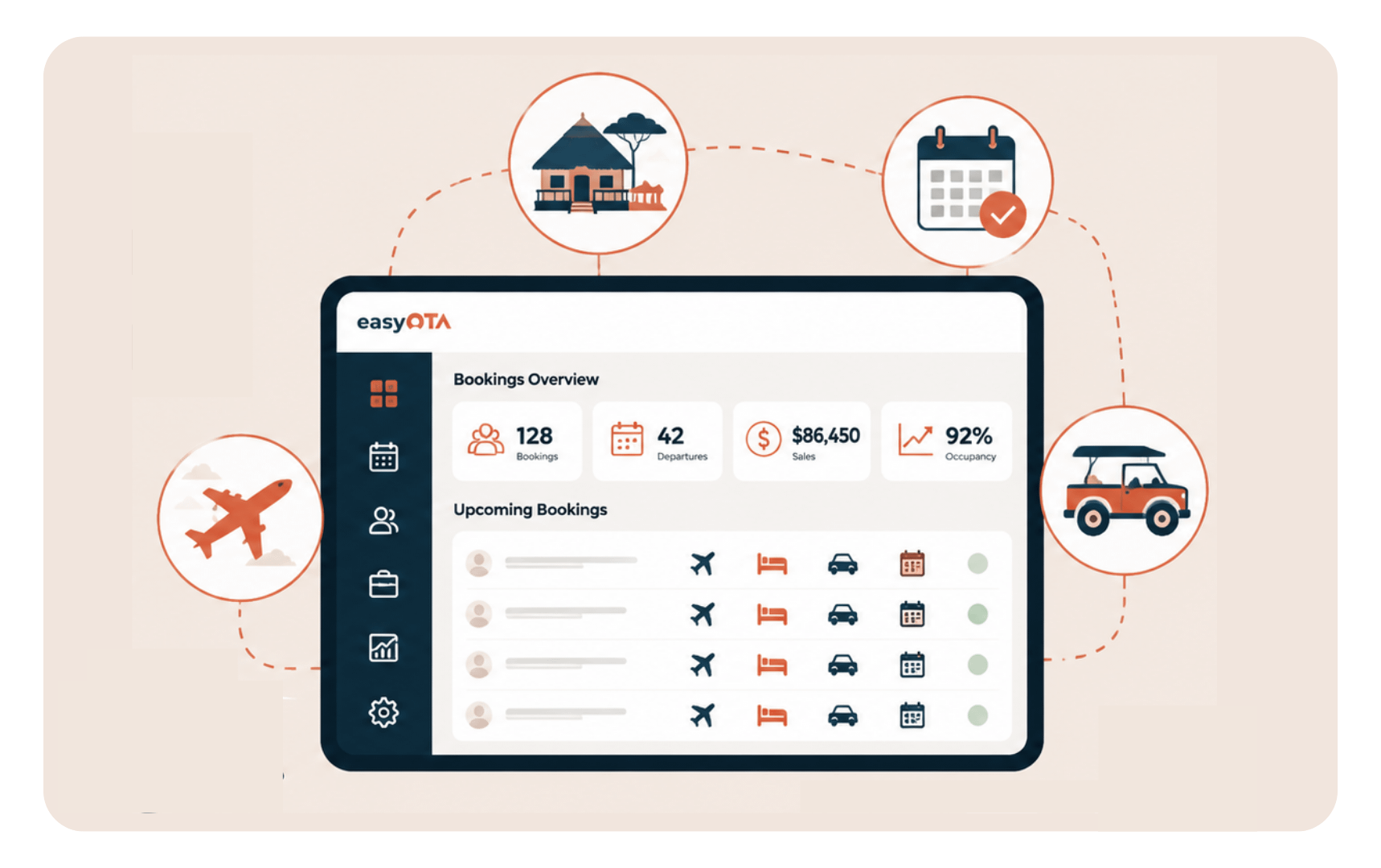
Growth is a good problem to have.
More enquiries, more agents and more bookings should mean your safari business is moving in the right direction.
But growth can quickly create another problem. The systems that worked when you were handling a smaller number of bookings start to become harder to manage.
Spreadsheets get bigger. Email chains get longer. Supplier rates become harder to track. More people need access to the same information.
Before long, your team can spend more time managing bookings than selling safaris.
Learning how to manage safari bookings online effectively is therefore about more than replacing spreadsheets. It is about creating a booking process that can cope with increasing volume without increasing complexity at the same rate.
- Bring Your Safari Booking Process Into One Place
Safari bookings contain a lot of moving parts.
A single itinerary can include accommodation, experiences, flights, transfers, park fees and optional extras, often across multiple suppliers.
When those elements are managed across separate spreadsheets, inboxes and documents, it becomes harder to maintain a clear picture of each booking.
A central safari booking system gives your team one place to manage the journey from initial enquiry through to confirmation.
That means being able to see:
- Client and booking information
- Supplier details
- Quote versions
- Availability
- Pricing and markups
- Deposits
- Provisional bookings
- Cancellations
- Confirmed services
Having that information together makes it easier for different team members to understand exactly where a booking stands.
It also reduces reliance on knowledge sitting with one person.
- Build Quotes Using Accurate Rates and Availability
Quoting is often one of the most time-consuming parts of managing safari bookings.
A detailed safari quote might involve checking several accommodation options, applying different NET rates, adding experiences, calculating park fees and factoring in transport.
Doing this manually creates opportunities for delays and errors.
A safari booking platform should allow your team to manage supplier pricing inside the system and use those rates when creating quotes.
With EasyOTA, safari businesses can work with their own NET rates and markups, while also accessing live availability when building itineraries.
This means the quote starts with more accurate information rather than requiring repeated checks later in the sales process.
It also makes it easier to respond quickly when a client wants an alternative property, different travel dates or another itinerary option.
- Manage Multiple Suppliers Without Endless Email Threads
The complexity of safari booking often sits behind the scenes.
The traveller may see one itinerary.
Your team sees multiple suppliers.
There may be several lodges, transfers, activities and flights to coordinate before that itinerary becomes a confirmed trip.
As booking volumes grow, relying on email alone becomes increasingly difficult. Important information can sit across different inboxes and supplier conversations, making it harder to see what has been confirmed and what still needs attention.
Bringing supplier information into the booking process gives your team greater visibility.
Live availability can reduce the need for repeated availability checks, while centralised booking information makes it easier to keep track of the components within each itinerary.
The objective is simple: fewer places to check before you know what is happening.
- Give Agents the Information They Need
For many safari businesses, agents are an important source of bookings.
But they can also generate significant administration if every rate request, availability check or booking question needs to pass through your internal team.
A structured agent portal can remove much of this friction.
With EasyOTA, agents can have secure logins with pricing and terms tailored to their relationship with your business.
Agent pricing groups can be used to control what different partners see, including NET rates, rack pricing and payment arrangements.
This allows agents to work more independently while the operator keeps control of pricing and access.
As the agent network grows, this becomes increasingly important.
Adding more partners should increase sales opportunities, rather than simply creating more emails for your team.
- Keep Provisional Bookings, Deposits and Cancellations Under Control
A safari booking does not move directly from enquiry to confirmed travel.
 Book a demo to see how we support success in our partners.