
It feels almost impossible to have a conversation about travel technology at the moment without AI becoming part of it, and there is good reason for that.
The travel industry is moving quickly. According to Phocuswright’s Travel Innovation and Technology Trends 2026, 61% of travel executives are already experimenting with or scaling agentic AI, while 83% of travel businesses are using generative AI in some capacity.
At the end of July, Expedia Group also acquired AI trip planning and booking app Layla, another clear sign that some of the largest businesses in travel expect AI to play a growing role in the way people discover, plan and eventually book trips.
I find all of this fascinating. I have spent most of my career looking at how technology can solve problems in African travel, so I certainly believe AI has a role to play in the future of safari.
What concerns me is that parts of the industry may be jumping ahead of the problem they actually need to solve.
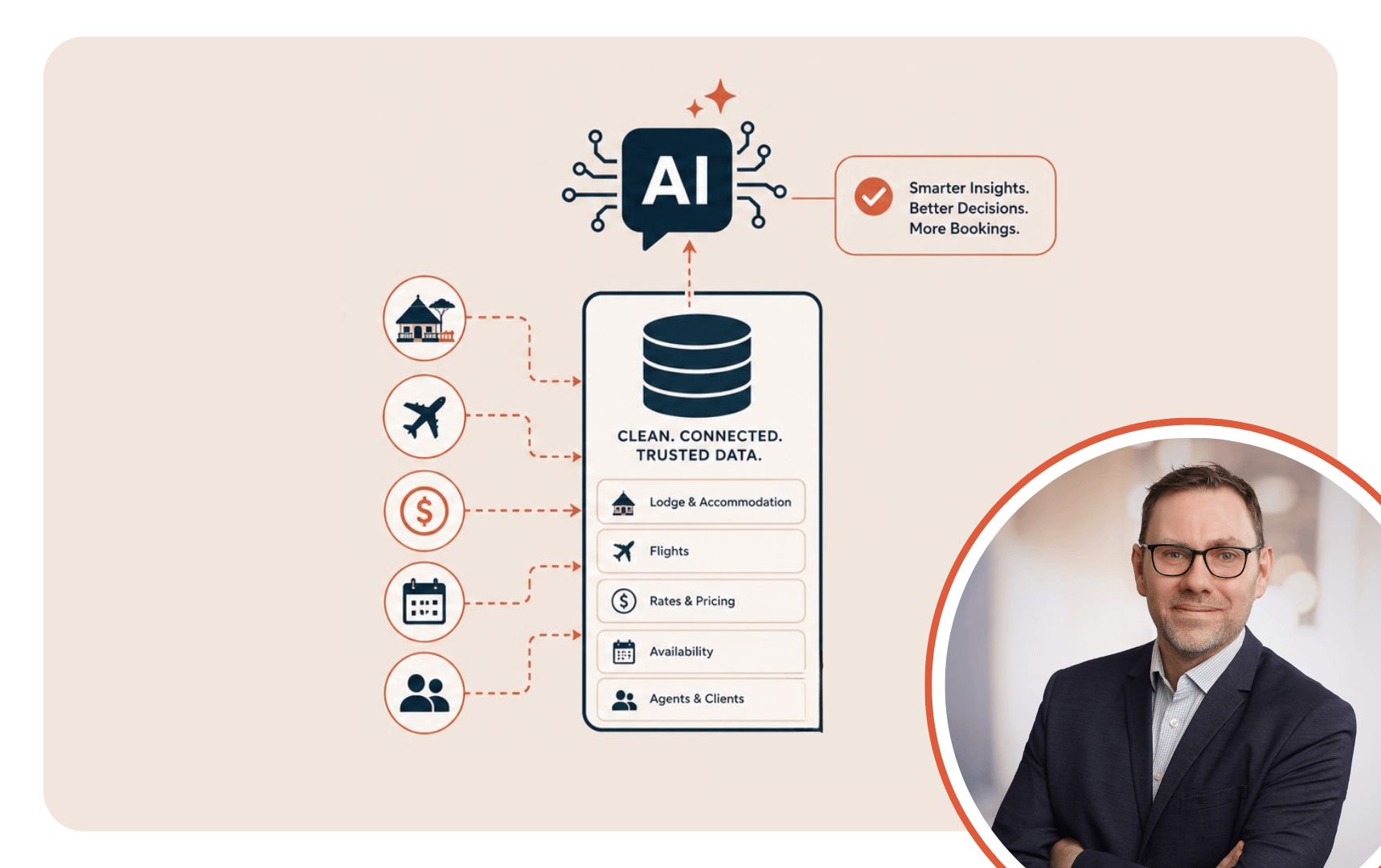
AI can analyse information, organise it and increasingly act upon it. What it cannot do particularly well is compensate for information that is fragmented, unavailable or out of date. For many travel businesses, getting that underlying information in order remains the more immediate challenge.
Africa Is Moving Quickly on AI, but the Foundations Matter
One recent piece of research particularly caught my attention.
A global hospitality technology study conducted by h2c and commissioned by Profitroom found that 57% of hotel businesses in the Middle East and Africa had already integrated AI-driven features into their products and services, compared with a global average of 35%.
That puts the region ahead of Europe, the Americas and Asia-Pacific.
However, the same research also found that 47% of Middle East and African hotel chains said departmental data silos were limiting their AI adoption.
The African Travel & Tourism Association summary of the research is worth reading because those two figures tell an interesting story when placed alongside one another.
The appetite for AI is clearly there. The infrastructure underneath it is still catching up.
I think that is especially relevant to safari because of the complexity involved in creating and managing even a relatively straightforward itinerary.
Imagine asking an AI system to build an accurate safari proposal. It may need to understand which lodges are available, the current supplier rates, seasonal pricing, park fees, transfers, internal flights, experiences, room allocations and circuit discounts. If an agent is involved, it may also need to recognise which NET rates and commercial terms apply to that relationship.
Now imagine some of that information is held in spreadsheets, other parts are contained within PDFs, current availability is sitting in an email thread and the most recent supplier update has yet to make its way into the central rate sheet.
There may also be important information that exists solely because somebody in the business has worked with a supplier for ten years and simply knows how things work.
In that environment, the limitation is not the intelligence of the AI. It is the quality and accessibility of the information it has been given.
That is why I think the conversation around safari business automation needs to start slightly further down the technology stack. Before asking what AI could do for a safari business, it is worth asking whether the information within that business is organised well enough for AI to use in the first place.
The Less Exciting Technology May Be the Most Important
Clean data does not generate the same level of excitement as generative AI. Neither do structured supplier rates, live inventory, connected booking systems or well-maintained product information.
Yet those things are becoming increasingly important.
Phocuswright’s 2026 research identifies clean data governance as one of the immediate operational priorities businesses need to address as agentic AI develops.
A separate PhocusWire analysis looking at AI and travel distribution makes a similar argument from a distribution perspective. If AI agents begin playing a greater role in travel search and booking, information such as inventory, rates, availability and fees will need to be structured accurately enough for machines to understand and act upon it.
Safari presents a particularly interesting challenge here because the simplicity experienced by the traveller hides an enormous amount of operational complexity.
A beautifully presented seven-day itinerary might contain several accommodation providers, transport suppliers, different pricing structures, conservation or park fees, experiences, domestic flights and agreements with agents. Bringing that information together cleanly already makes safari businesses more efficient today.
In a future where AI becomes more deeply involved in travel planning and distribution, that same infrastructure may become even more important.
AI Could Also Change How Safari Businesses Are Discovered
There is another development that I think deserves attention.
AI is beginning to influence the discovery stage of travel as well as the operational side. Phocuswright reports that 39% of US travellers are now actively using AI when planning trips, up from 28% a year earlier.
Traditional search is clearly still hugely important, but the path towards a booking is beginning to change.
A traveller who might previously have searched Google, opened a dozen safari operator websites and compared the options themselves may increasingly ask an AI assistant to help narrow down the choice.
As those systems become more sophisticated, the quality and structure of the information available to them will influence what they are able to recommend.
That creates a new consideration for safari businesses. For years, we have thought carefully about how products, destinations and itineraries are presented to people. Increasingly, we may also need to consider whether that information can be clearly interpreted by the machines helping those people make decisions.
For me, this is where the discussion around AI becomes much more interesting than simply adding a chatbot to a website.
The Human Side of Safari Still Matters
At the same time, I would be very cautious about assuming that every part of the safari booking journey should become automated.
Expedia Group commissioned YouGov to survey more than 5,700 adults across the US, UK and India in March 2026. Its resulting AI Trust Gap report found that 68% preferred booking with a trusted travel brand rather than an AI chatbot or agent, even when AI booking was available. Only 8% said they felt comfortable booking through an AI platform.
I find that reassuring because safari is an industry where human expertise carries enormous value.
People may be spending thousands, sometimes tens of thousands, on a journey they have dreamed about for years. They want reassurance that the itinerary is right for them. They want somebody who understands whether a particular lodge suits their family, whether a particular route makes sense at that time of year, or whether adding another destination will genuinely improve their trip.
There is a difference between knowing that a room is available and knowing whether that room, lodge or experience is the right choice.
That distinction is where I believe people will remain incredibly important.
The opportunity for safari business automation is therefore to make good information easier to access and repetitive processes easier to manage, while giving specialists more time to apply their expertise where it actually matters.
Live availability, structured rates, connected booking information and automated calculations can make the operational side of a safari business significantly more efficient. That creates more space for teams to advise clients, solve problems, build relationships and design extraordinary journeys.
For me, that is a much more compelling use of technology than trying to remove people from the process altogether.
Getting Safari Ready for What Comes Next
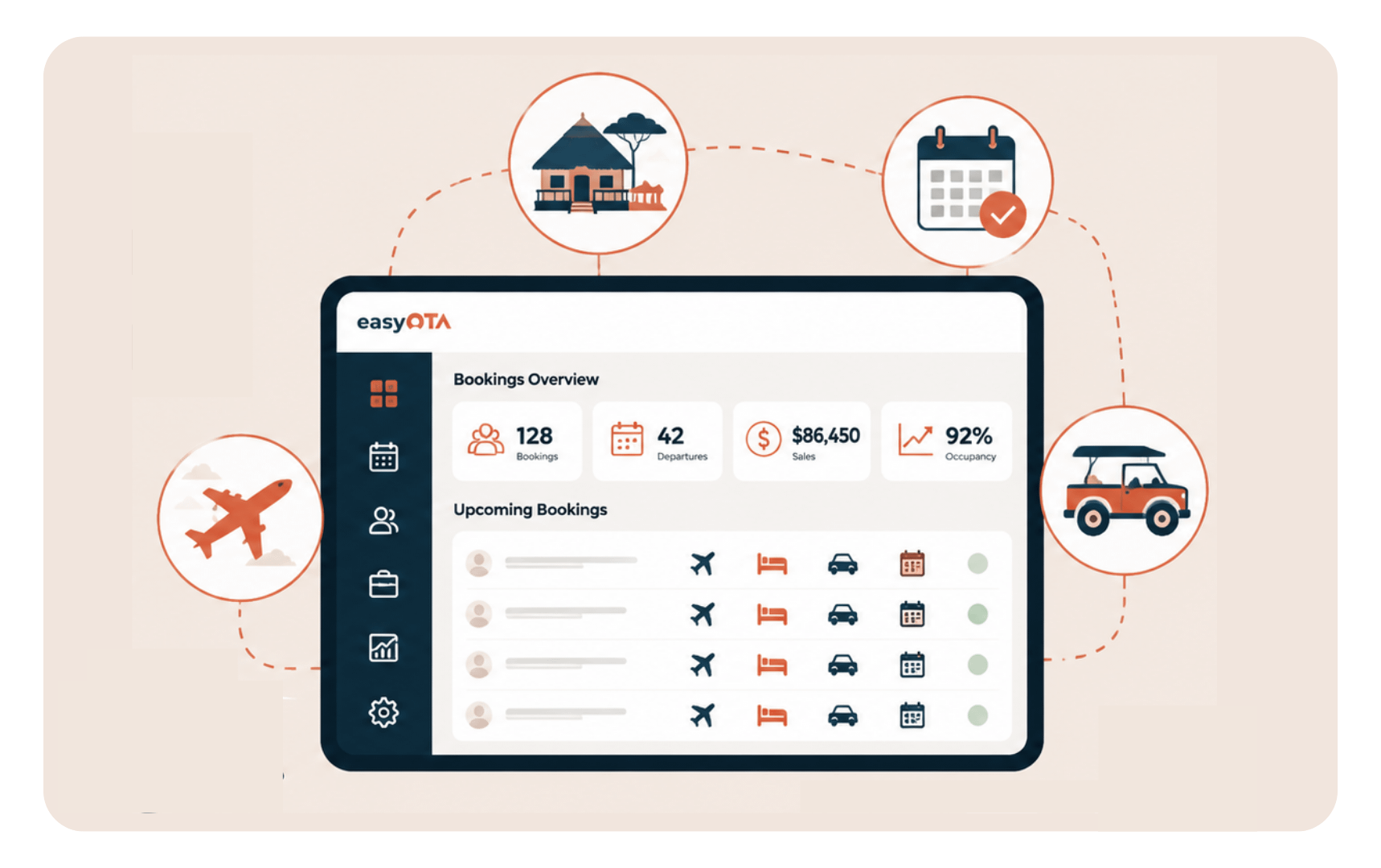
A lot of the thinking behind EasyOTA has always centred on bringing together information that safari businesses have traditionally had to manage manually.
Supplier information, live availability, NET rates, itinerary details, agent pricing and booking information all become more valuable when they form part of connected processes.
Today, that helps safari businesses create quotes more quickly, manage bookings more effectively and reduce the amount of repetitive work undertaken by their teams.
Over time, I think those same foundations will determine how effectively businesses can take advantage of the next generation of travel technology.
That is why I think some of the current discussion around AI is focused too heavily on what sits at the top.
The safari industry certainly needs to understand AI and experiment with where it can add value. It also needs to make sure the information underneath its businesses is accurate, structured, accessible and connected.
AI can do increasingly remarkable things with good information. It is far less useful when asked to interpret twenty years of spreadsheets, email threads and knowledge that has never left somebody’s head.
Getting those foundations right may sound less exciting than talking about AI agents planning entire safaris.
I suspect it will prove far more important.
Sources referenced:
African Travel & Tourism Association: Africa’s Hotel Sector Leads the World in AI Adoption
Phocuswright: Travel Innovation and Technology Trends 2026
Expedia Group: The AI Trust Gap
PhocusWire: AI is the Next Productivity Shock: Can Travel Reap the Gains?
PhocusWire: Expedia Calls on Layla to Speed Up its AI Strategy
 Book a demo to see how we support success in our partners.