
If a client goes quiet after receiving your itinerary, the problem probably isn’t the price.
In our experience working with safari operators across East Africa, there’s a moment that nearly every team recognises but rarely talks about openly: you’ve sent a beautifully crafted itinerary, followed it up once, maybe twice, and then nothing. The client disappears.
It’s easy to blame the price. Or the timing. Or assume they booked somewhere else.
Sometimes that’s true. But often, more often than most operators would like to admit, the silence is feedback. It’s the client telling you, without saying a word, that something in the proposal didn’t make them feel ready to commit.
This piece is about understanding what that silence actually means, and how to build proposals that move clients forward instead of leaving them stuck.
The Invisible Decision Point in Every Safari Booking
Safari bookings are high-consideration purchases. We’re talking about significant amounts of money, often once-in-a-lifetime experiences, and decisions that involve multiple people, partners, families, sometimes corporate travel managers.
The moment a client receives your itinerary is a pivotal one. They’re not just reading about lodges and game drives. They’re trying to answer a deeper question: do I trust this?
Do I trust that this company knows what they’re doing?
Do I trust that this route makes sense?
Do I trust that the price reflects what I’m actually getting?
Do I trust that if something goes wrong, I’m in good hands?
A great itinerary answers all of those questions before the client thinks to ask them. A poor one, even if the underlying safari is exceptional, leaves them uncertain. And uncertain clients don’t book. They go quiet.
What Makes a Client Go Cold
Let’s be specific. These are the most common reasons a genuinely interested client fails to move forward after receiving a proposal.
The pricing doesn’t add up, visually
Not because it’s wrong. But because it’s presented in a way that makes it hard to understand what you’re getting for the money. A single total figure with vague inclusions doesn’t build confidence. A clear daily breakdown, with named properties, specific park fees, and stated inclusions, does.
The itinerary reads like a spreadsheet
Bullet points and accommodation names are necessary, but they’re not sufficient. If your proposal doesn’t convey what it actually feels like to move between the Serengeti and Ngorongoro, to wake up in a tented camp in the Masai Mara, to witness a wildebeest crossing from a riverbank, you’re describing logistics, not selling a dream. Clients need both.
The presentation looks unfinished
First impressions are formed fast. A proposal that arrives as a plain Word document, or a PDF that looks like it was designed in 2008, signals something about the operator before a single word is read. It suggests the same standard of attention applies to the safari itself. That’s often unfair, but it’s human.
There’s no clear next step
What does the client do if they want to proceed? Is there a deposit amount? A booking deadline? A process for requesting changes? Many proposals leave clients in limbo, they want to say yes, but they’re not sure how, and asking feels awkward. Clarity on next steps removes that friction entirely.
The follow-up was too slow
In a world where travellers can compare flights, hotels, and experiences in real time, a 48-hour wait for an itinerary revision feels like a long time. Not because safari should feel transactional, but because the speed of your response communicates how organised your operation is. Slow responses plant seeds of doubt.
The Itinerary That Closes
The best safari proposals share a common quality: they make the decision easy.
They’re visually compelling without being cluttered. They balance emotional language, the kind that makes a client imagine themselves there, with practical information that justifies the investment. They’re honest about what’s included and what’s not. They present pricing in a way that’s transparent, not opaque. And they make the next step obvious.
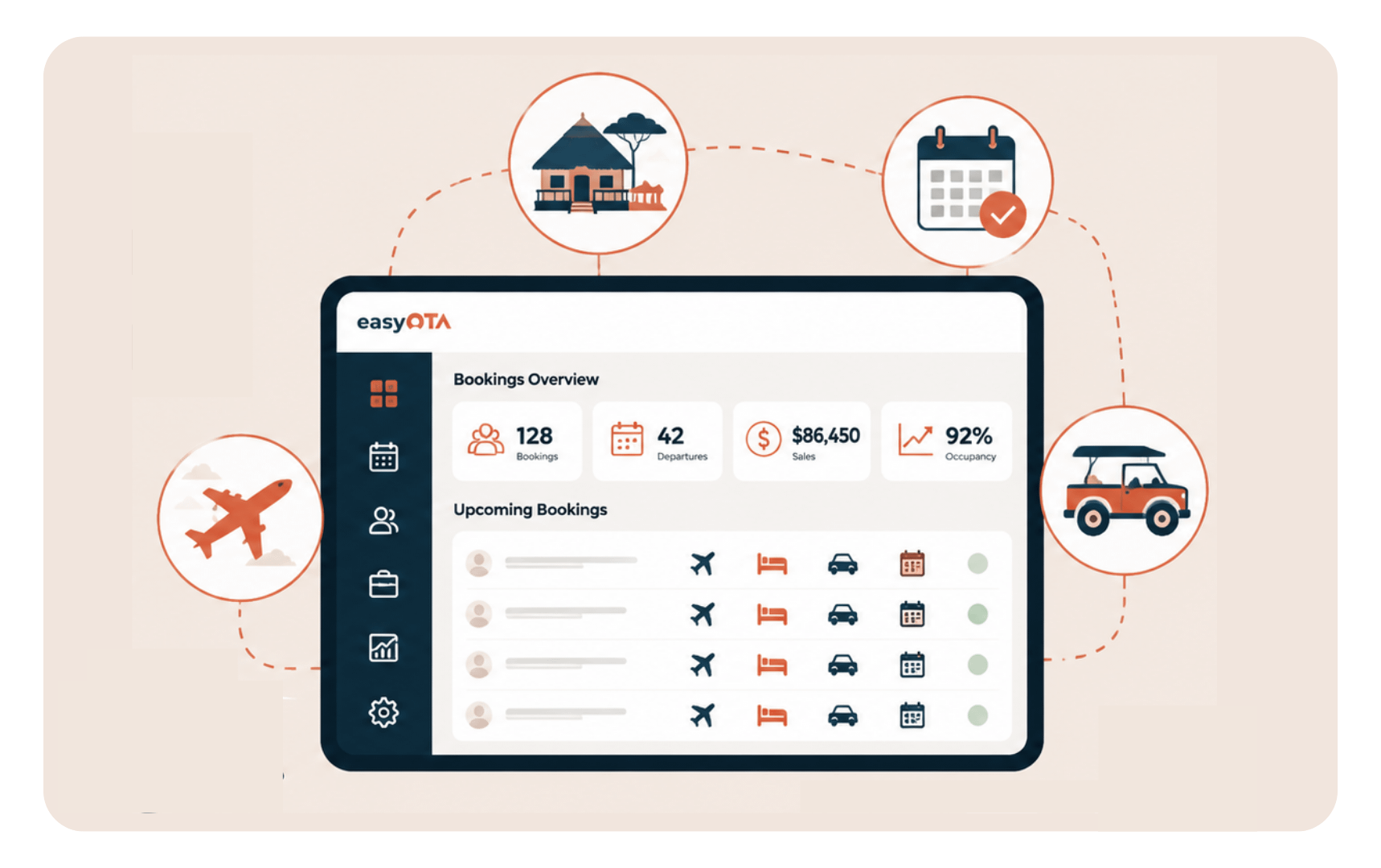
They also tend to be built quickly. Not because corners are cut, but because the operator has systems that handle the complexity, the rate lookups, the park fee calculations, the circuit discount applications — automatically. The team’s energy goes into the client relationship and the storytelling, not the mechanics of the quote.
There’s a meaningful difference between a quote that tells a client what a safari costs and a proposal that makes them feel what a safari is worth. The latter converts. The former often doesn’t.
Rethinking What Conversion Means
Most operators measure conversion at the point of booking. The enquiry came in, the quote went out, and either a deposit arrived or it didn’t.
But conversion starts much earlier than that. It starts with the first impression your proposal makes. It continues through every piece of information you provide and every friction point you either remove or leave in place.
Operators who understand this tend to think about their proposals the way a good salesperson thinks about a pitch. Not as a document to deliver, but as an experience to design.
The client who went quiet after your last proposal wasn’t necessarily saying no. They were saying: ‘I’m not quite ready yet, and something in what you sent didn’t give me the push I needed.’
That’s addressable. Sometimes a better follow-up is enough. But more often, it means looking honestly at what you sent and asking: did this make it easy to say yes?
If the answer is anything other than ‘absolutely’, that’s where to start.
 Book a demo to see how we support success in our partners.