
You’ve done the hard part. Your safari product is outstanding. So why are enquiries going quiet?
It’s a question you hear from operators across East Africa more often than you’d think. A prospective guest makes contact, the team responds, a quote goes out, and then nothing. The lead goes cold.
In most cases, the operators assume the client found a cheaper option, or simply changed their mind. Occasionally that’s true. But far more often, the real culprit is something closer to home: the way the pricing was structured and presented in the first place.
Safari pricing is genuinely complex. That’s not an excuse, it’s a fact. You’re managing park fees that vary by nationality and residency, circuit discounts that stack across lodges, seasonal rate shifts, agent NET rates that differ by market, and multi-currency expectations from clients booking from four different continents. No other travel vertical has this many pricing variables in a single itinerary.
But complexity doesn’t have to become confusion. And confusion is what loses bookings.
The Problem with ‘Pricing by Spreadsheet’
Most operators probably started their pricing life in a spreadsheet. That’s not unusual, it made sense when the business was smaller, the product was simpler, and enquiries came in at a manageable pace.
The problem is that spreadsheets don’t scale cleanly. They grow sideways. Columns multiply. Tabs breed other tabs. And somewhere in the middle of that, human error becomes not a possibility but an inevitability.
A rate gets carried over from last season. A park fee gets missed on a specific nationality. A circuit discount doesn’t get applied. The quote goes out with pricing that’s either too high — and the client doesn’t convert — or too low — and the operator carries the loss.
Neither outcome is acceptable. And both are entirely avoidable.
What Safari Pricing Should Actually Look Like
Good safari pricing isn’t just about the numbers being right. It’s about the numbers being visible, logical, and easy for the client to understand.
When a client receives a quote and they can’t immediately see why things cost what they cost because the breakdown is vague, the inclusions are buried in a footnote, and the park fees are wrapped inside a catch-all total, doubt creeps in. And doubt is the enemy of a confirmed booking.
The operators who convert consistently tend to do a few things differently.
They show the work. Not in a way that overwhelms the client, but enough to demonstrate that the pricing is considered and accurate. A clear daily breakdown, named lodges, specified park fees, and a visible deposit structure all build confidence.
They align pricing to the client’s currency. A UK traveller receiving a quote in USD is already doing mental maths before they’ve even read the itinerary. Multi-currency presentation isn’t a luxury, it’s a conversion tool.
They manage agent rates carefully. Giving every agent the same rate sheet is a missed opportunity. Safari DMCs with strong agent networks know that NET rate groups, controlled, agent-specific pricing that agents can apply markup to, protect margin and incentivise the agent to push your product over a competitor’s.
They apply circuit discounts automatically. Circuit discounts, where clients receive a reduction for staying across multiple properties in a group or consortium, are a powerful conversion tool. But they only work if they’re applied consistently. Manual application means they get forgotten, misapplied, or inconsistently offered, which can also create awkward conversations with agents who’ve promised a client a discount that never appeared on the final quote.
The Conversion Gap Nobody Talks About
Here’s something worth sitting with: most operators track enquiry volume and confirmed bookings. Very few track the gap between the two with any precision.
That gap, the enquiries that received a quote but never converted, is where the real cost of poor pricing lives.
In high-demand seasons, this feels invisible. Business is good. The pipeline is full. But in other seasons, when every booking counts, the gap between a clear, compelling quote and a confusing one can represent a material difference in revenue.
Speed matters too. A quote that takes 48 hours to arrive is competing against a world where travellers can book flights in 30 seconds. That doesn’t mean safari should feel transactional, it absolutely shouldn’t. But it does mean that a faster, accurate quote from you will consistently outperform a slower, more manual one from your competitor.
Pricing Clarity as a Competitive Advantage
The operators in East Africa who are growing fastest right now aren’t necessarily the ones with the best lodges on their books, or the lowest prices, or even the most experienced teams.
They’re the ones who’ve made it easy to say yes.
Clear pricing. Fast quotes. Logical itinerary structure. Transparent inclusions and exclusions. A deposit process that doesn’t feel like a barrier. These aren’t back-office details — they’re front-line sales tools.
If your pricing is complex on the inside but simple on the outside, you’ve built something genuinely powerful. If it’s complex on both sides, you’re working harder than you need to for every single booking.
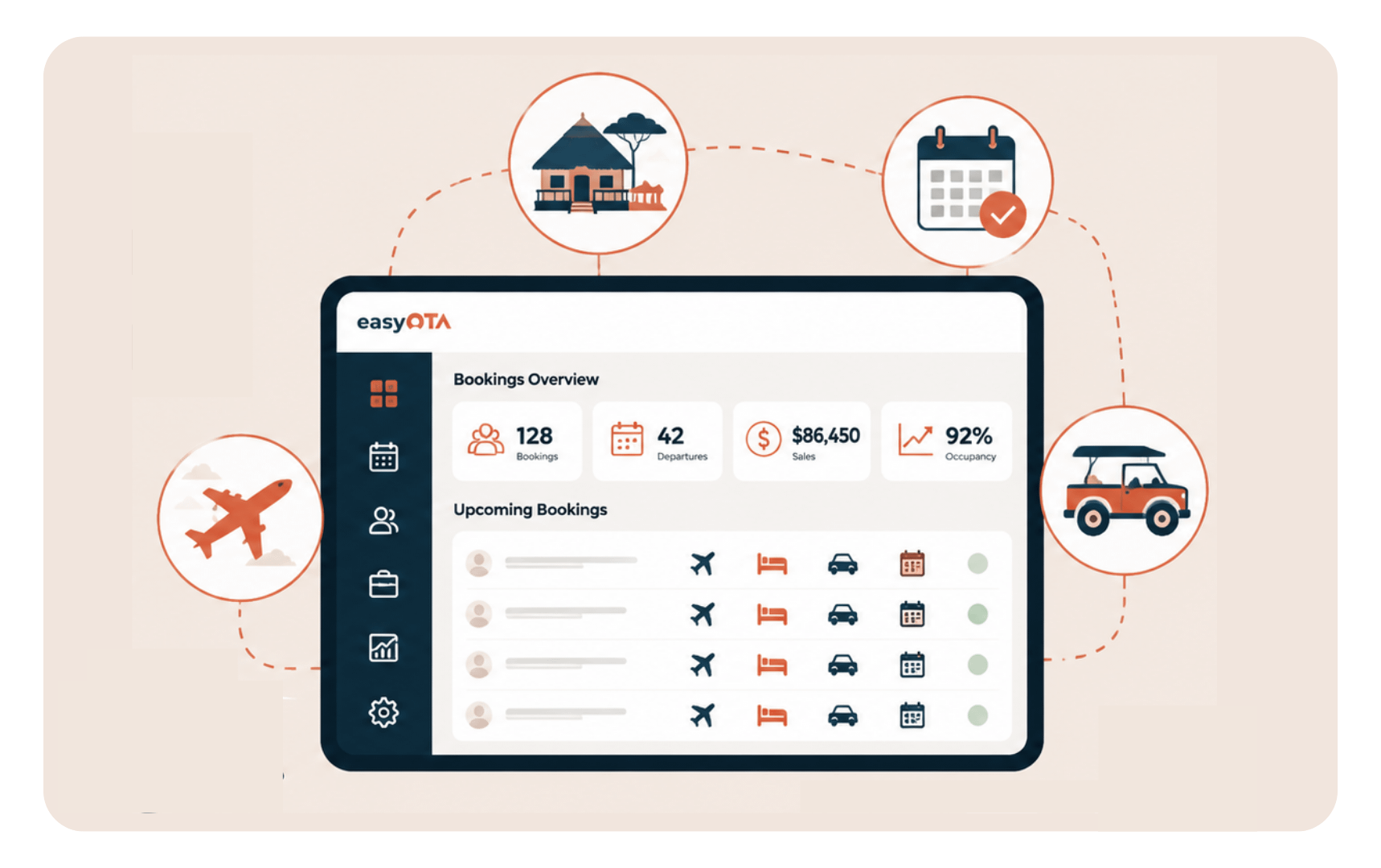
The good news is that complexity can be systematised. The variables that make safari pricing difficult — the park fees, the circuit logic, the seasonal rates, the agent tiers — can all be embedded into a system that does the heavy lifting behind the scenes and produces a clean, confident quote at the front end.
That’s not about removing the human expertise from your quoting process. It’s about removing the friction.
Your clients don’t need to see how hard it is to build a great safari. They just need to feel how easy it is to book one.
 Book a demo to see how we support success in our partners.